Product guidance
The Future of Portable Identity: Why Your Business Needs a Decentralized Profile Strategy
Explore how portable digital identity shapes contact-data management and how public-avatar signals support cross-platform profile consistency.
As digital communication shifts away from centralized silos, portable digital identity concepts help organizations manage contact-data consistency across platforms using public profile signals.
Portable digital identity represents a model where users maintain digital presence attributes across multiple independent platforms rather than remaining confined to a single centralized provider. For businesses, this shift challenges traditional contact-data management because customer touchpoints are spread across fragmented ecosystems. A decentralized profile strategy helps organizations adapt by evaluating public signals across external messaging and email networks. By incorporating public-avatar detection into contact-data workflows, teams can review public profile indicators tied to supported account identifiers, supporting cross-platform consistency and helping organizations keep internal CRM records aligned with changing communication channels.
The Shift Toward Portable Digital Identity
Digital identity has historically depended on centralized platforms that store user data within closed silos. In these walled gardens, profile updates, contact preferences, and public avatars remain trapped within single networks. When users transition between communication apps or manage multiple handles, enterprise contact records quickly become stale. The growing movement toward portable digital identity emphasizes user ownership and cross-platform mobility. Individuals increasingly maintain their digital personas across decentralized or distinct social and messaging spaces rather than rebuilding their presence from scratch. For businesses, relying strictly on centralized repositories creates operational friction, as static records fail to reflect cross-channel presence. Adopting a decentralized profile strategy allows organizations to recognize that identity markers are distributed across diverse networks, requiring flexible workflows to evaluate records against external, platform-specific touchpoints.
Bridging the Gap: The Role of Public Profile Signals
Managing records across distributed communication environments requires practical bridges between internal databases and third-party networks. Public profile signals provide observable indicators that help teams audit contact-data consistency without intruding on private accounts. AvatarLookup functions as a focused public-avatar detection platform for teams reviewing supported account identifiers within contact-data workflows. By querying public profile indicators, organizations can confirm whether an identifier displays a public image or associated public profile fields on specific platforms. This check provides neutral context for CRM hygiene. Rather than attempting to maintain rigid master profiles, teams use public-avatar availability to evaluate whether a record corresponds to an active public presence, supporting better segmentation and routing across outreach workflows.
Operationalizing Identity Consistency Across Channels
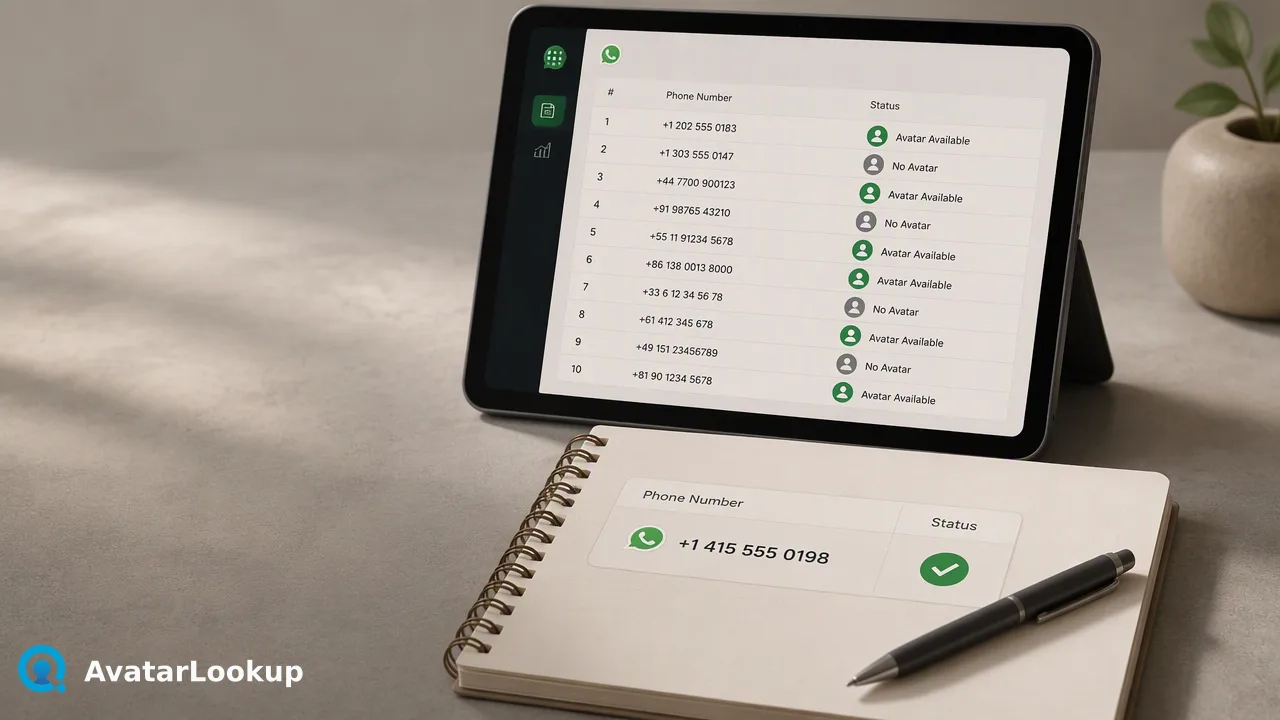
Implementing a profile strategy requires clear distinctions between query models and platform capabilities. Teams evaluate contact records through both real-time individual lookups and large-scale asynchronous auditing. Single avatar checks support WhatsApp, Gmail, Yandex, and Mail.ru via phone numbers or email addresses, making them practical for real-time contact validation during record entry. For broader database hygiene, bulk avatar checks accept CSV, TXT, and XLSX files of up to 10 MB and 100,000 entries. Bulk tasks process an expanded source list, including WhatsApp, Telegram, Viber, LINE, Zalo, MAX, Gmail, Yandex, and Mail.ru. Note that Telegram, Viber, LINE, Zalo, and MAX are bulk-only sources, whereas LinkedIn is not supported. Bulk workflows report outcomes into distinct statuses: avatar available, no avatar, and undetermined. An outcome of 'no avatar' does not mean an account does not exist, nor is 'undetermined' a negative outcome; both simply describe the public signal state at check time.
Maintaining Trust and Boundary Discipline
A sustainable decentralized profile strategy requires strict boundaries regarding what public signals represent. Furthermore, any auxiliary appearance attributes—such as estimated age range, presented gender, skin-tone features, or hair color—are purely algorithmic estimates derived from image analysis. Organizations must never treat these estimates as verified demographic facts or use them for sensitive, legal, or high-impact decision-making. By maintaining clarity on these boundaries, organizations respect user privacy while effectively maintaining data hygiene across independent communication networks.
FAQ
How does public-avatar detection support contact-data consistency?
Public-avatar detection checks whether a supported email or phone identifier has a publicly accessible avatar on a specific platform. Teams use this check-time observation to confirm whether records show active public profile indicators across channels, which helps staff review contact lists and spot outdated identifiers without relying on static, closed databases.
What is the operational difference between single and bulk avatar checks?
Single checks evaluate individual identifiers across WhatsApp, Gmail, Yandex, and Mail.ru. Bulk tasks process CSV, TXT, or XLSX files up to 10 MB and 100,000 entries across WhatsApp, Telegram, Viber, LINE, Zalo, MAX, Gmail, Yandex, and Mail.ru, categorizing avatar available, no avatar, and undetermined outcomes.
How should teams interpret algorithmic appearance attributes?
Appearance attributes such as estimated age range, presented gender, or hair color are automated algorithmic inferences derived from an image. They function strictly as auxiliary references during internal reviews and must never be treated as verified demographic facts or used for discriminatory decisions.
Learn More
Choose the product information that fits the next step in your workflow.