
Product guidance
The Strategic Value of Consistent Digital Avatars in Professional Identity
Discover how consistent digital avatars support professional identity and learn how to audit contact data using public-avatar detection workflows.
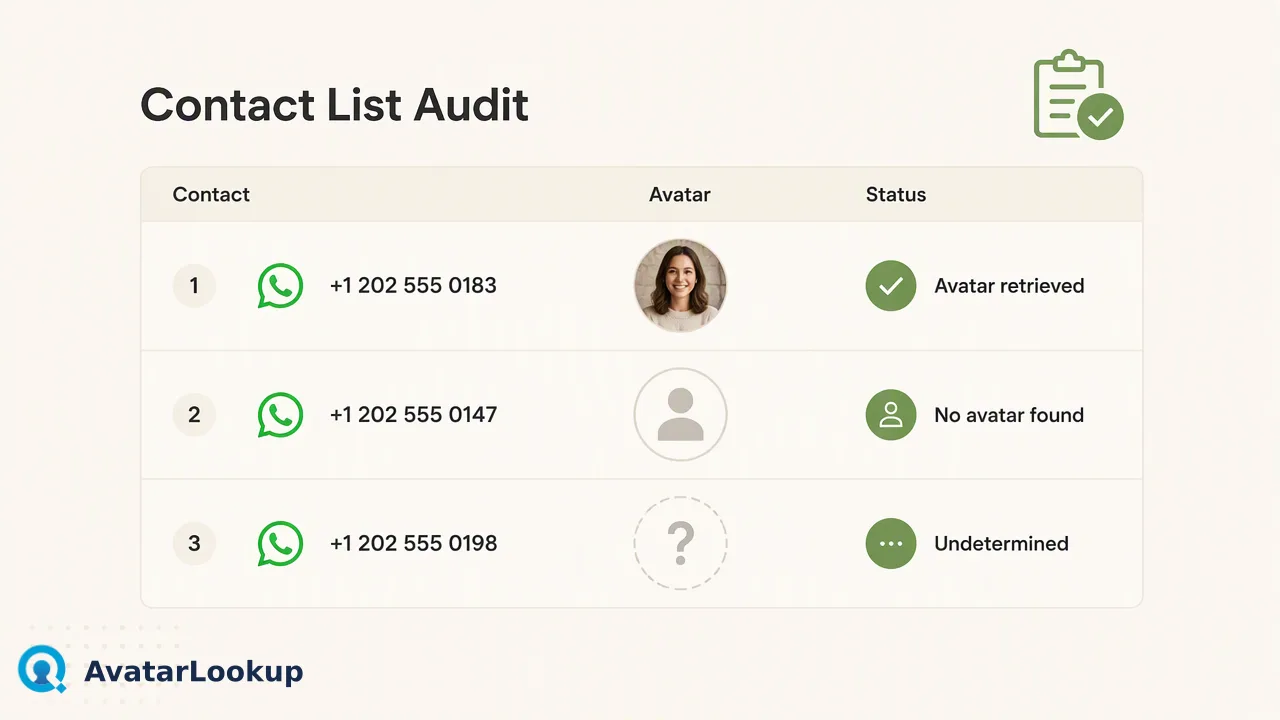
Explore how consistent digital avatars support professional identity and learn how teams can audit contact data using public-avatar detection workflows.
Consistent digital avatars serve as a primary visual cue for brand recognition and professional trust. By auditing contact data for avatar availability, organizations can reduce cognitive friction for their clients, support a cohesive professional presence across messaging platforms, and bridge the gap between technical data and human connection. AvatarLookup provides a focused public-avatar detection platform for teams that need to review supported account identifiers in contact-data workflows. Checking these public signals helps teams understand which contacts present a recognizable visual identity across channels like WhatsApp or Gmail. This visibility informs internal communication strategies and supports data-quality initiatives without relying on manual profile reviews, allowing organizations to maintain a polished, professional digital footprint.
The Evolution of Digital Identity
Professional identity is no longer strictly text-based. Digital avatars have evolved from simple profile pictures into critical brand assets that drive user engagement and trust across digital touchpoints. In modern business environments, avatars bridge the gap between technical data and human connection, providing a recognizable face to otherwise anonymous email addresses or phone numbers. When organizations communicate with clients, a visible avatar serves as an immediate visual cue for brand recognition and recall. Teams managing contact-data workflows increasingly recognize that visual consistency supports a more professional and trustworthy appearance. By treating public avatars as strategic assets rather than mere decorative elements, organizations can better align their digital presence with their broader communication goals. Reviewing public-avatar availability helps teams assess the current state of their contact databases, providing valuable context for outreach prioritization and relationship management across supported messaging and email platforms.
Why Consistency Matters for Professional Presence
Inconsistent profile imagery creates cognitive friction for users and potential clients. When a professional contact displays a recognizable avatar on one platform but lacks any visual identifier on another, it disrupts the cohesive experience expected in modern business communications. Centralized management of identity assets supports a unified professional presence, helping teams project reliability and competence. Organizations that audit their contact lists for avatar availability can identify gaps where visual identifiers are missing. Addressing these inconsistencies helps streamline client interactions and reinforces brand familiarity. By understanding which identifiers have an associated public avatar, teams can make informed decisions about their communication channels, ultimately contributing to higher engagement and a more polished professional image across digital touchpoints.
Auditing Identity Assets at Scale
Organizations managing large databases require efficient methods to review contact records. Teams can use public-avatar detection to review supported account identifiers at scale, gaining visibility into whether an account has an avatar set. AvatarLookup supports asynchronous bulk processing, allowing teams to process supported messaging and email identifiers in a single bulk file. A bulk file can contain up to 100,000 entries and must not exceed 10 megabytes, with accepted formats including CSV, TXT, and XLSX. This bulk capability supports platforms like WhatsApp, Telegram, Viber, LINE, Zalo, MAX, Gmail, Yandex, and Mail.ru. By retaining clear avatar conclusions separately from invalid, failed, or undetermined rows, teams can efficiently audit large contact lists. This workflow informs internal data-quality reviews and helps organizations prioritize updates to their professional communication channels without the operational burden of checking individual profiles manually.
Evaluating Single and Bulk Avatar Checks
Different contact-data workflows require different approaches to public-avatar detection. Single avatar checks are ideal for targeted reviews, supporting platforms like WhatsApp, Gmail, Yandex, and Mail.ru using a supported phone number or email address. This single-check capability returns a public avatar signal for immediate context during individual record reviews. Conversely, bulk tasks are designed for comprehensive database audits and support a broader range of platforms. Notably, Telegram, Viber, LINE, Zalo, and MAX are available exclusively as bulk-only sources. Neither method supports LinkedIn. By selecting the appropriate check type, teams can tailor their data-quality initiatives to match their operational requirements. Whether processing a single new contact or auditing an entire CRM list, these checks provide a source-specific public profile signal that helps organizations understand the visual presence associated with their professional identifiers across various communication networks.
Understanding Public-Avatar Signals
Interpreting public-avatar signals correctly is essential for effective contact-data workflows. Core results distinguish between avatar available, no avatar, and undetermined. It is important to note that a "no avatar" result does not mean the account does not exist; it simply indicates the absence of a public image. Similarly, an "undetermined" outcome is not a negative result. Furthermore, avatar availability is strictly a public signal.
Navigating Algorithmic Appearance Estimates
When reviewing public-avatar signals, teams may encounter source-specific public profile fields and appearance attributes. These attributes, which may include presented gender, age range, hair color, skin-tone features, or appearance ethnicity, are strictly algorithmic estimates derived from an avatar image. Organizations must treat these estimates with caution, recognizing that they do not represent verified user data. These algorithmic outputs should inform general workflow context rather than drive high-impact decisions, discriminatory screening, or unauthorized profiling. By understanding the limitations of these estimates, teams can responsibly integrate public-avatar detection into their data-quality processes. The focus remains on assessing visual consistency and public presence, supporting contact-data workflows with additional context while strictly avoiding the misapplication of algorithmic estimates as factual demographic or identity proof.
FAQ
Why is avatar consistency important for professional communication?
Consistent digital avatars serve as a primary visual cue for brand recognition and recall. Inconsistent profile imagery creates cognitive friction for users and potential clients, disrupting the professional experience. Centralized management of identity assets supports a cohesive professional presence across digital touchpoints. By maintaining visual consistency, organizations can bridge the gap between technical data and human connection, which contributes to higher engagement and builds trust during client interactions.
How can teams audit their contact lists for avatar availability?
Teams can use public-avatar detection platforms like AvatarLookup to review supported account identifiers. For large databases, asynchronous bulk processing allows organizations to upload files containing up to 100,000 entries in CSV, TXT, or XLSX formats. This process checks platforms like WhatsApp, Telegram, and Gmail, retaining clear avatar conclusions separately from undetermined rows. This workflow helps teams efficiently assess the visual presence of their professional contacts at scale.
What is the difference between single and bulk avatar checks?
Single checks process one identifier at a time and support platforms like WhatsApp, Gmail, Yandex, and Mail.ru. Bulk checks process up to 100,000 entries simultaneously and support additional bulk-only sources, including Telegram, Viber, LINE, Zalo, and MAX. Both methods return a public-avatar signal to inform contact-data workflows, but bulk processing is designed for large-scale database audits, while single checks provide immediate context for individual record reviews.