
Product guidance
Deterministic User Identity Mapping: A Practical Guide
Learn how deterministic user identity mapping generates consistent visual assets and how public-avatar signals support contact-data review across platforms.
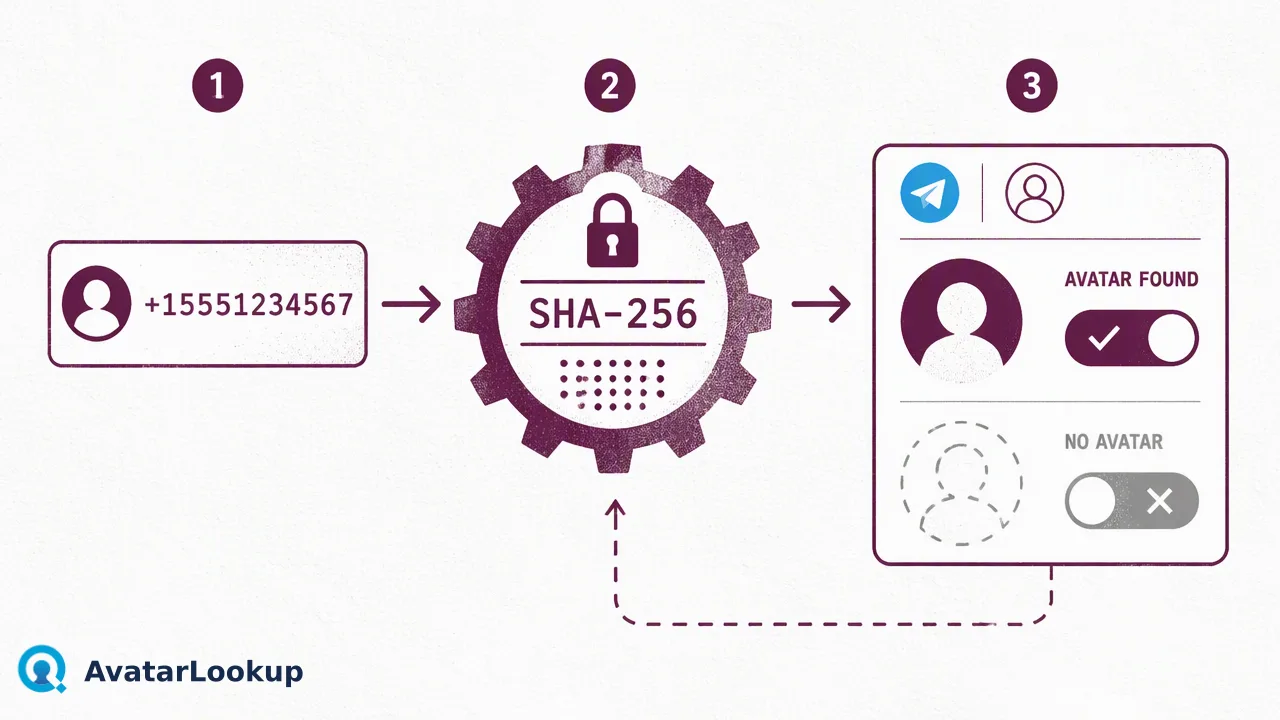
Explore how deterministic user identity mapping generates consistent visual assets across distributed platforms and how public-avatar signals support contact-data review.
Deterministic user identity mapping uses fixed input seeds to generate reproducible visual representations across distributed applications without storing static image files. By passing a stable identifier—such as an internal account hash—into a deterministic rendering algorithm, separate services produce the exact same visual asset every time. In contact-data workflows, teams combine this reproducible generation with public-avatar detection to review external accounts across communication channels. Platforms like AvatarLookup provide public-avatar availability signals for supported email and messaging identifiers, giving teams context to audit contact records and maintain structured visual representations across distributed systems.
The Role of Seed Values in Deterministic Identity Mapping
A deterministic seed is a fixed input string or numerical value fed into an algorithm to guarantee identical output across multiple executions. In distributed architectures, applications frequently need default graphical representations when external profile imagery is absent. Rather than assigning random patterns that shift across page reloads or device sessions, systems employ deterministic user identity mapping to bind a specific identifier to a consistent visual marker. When a client application or service executes the generator function using the designated seed, the underlying mathematical operations resolve to the exact same visual attributes. Styling parameters like base shapes, accent palettes, and geometric patterns remain uniform whether the routine executes in a backend environment or a client-side framework. By anchoring output to a canonical seed, organizations maintain visual continuity for user accounts across disparate interfaces.
Architectural Benefits of On-the-Fly Asset Generation
Generating identity assets programmatically on demand offers significant structural advantages over persisting static files in object storage. When an application renders visual markers directly from deterministic seeds, it avoids the storage footprint, backup overhead, and database complexity associated with millions of pre-rendered placeholder images. Because the seed and generation rules completely describe the end result, assets can be computed ephemerally by edge services or client applications whenever requested. Standard caching layers and content delivery networks can cache the resulting outputs downstream, reducing origin computation while eliminating database writes. Furthermore, if visual styles evolve, teams can update rendering templates programmatically rather than executing database migrations to recreate millions of stored image files. This dynamic approach keeps asset delivery reliable while maintaining a lightweight operational footprint.
Input Validation and Style Immutability for Multi-Platform Systems
Maintaining cross-platform visual consistency requires rigorous input validation alongside immutable style definitions. Because different programming languages and runtimes handle string encoding, whitespace, and hashing differently, unvalidated input seeds can produce divergent visuals for the exact same account. To safeguard consistency, systems should sanitize and normalize raw identifiers before seed generation. Recommended practices include converting strings to lowercase, trimming whitespace, and applying a standard cryptographic hash, such as SHA-256, to create a uniform seed value. Simultaneously, visual configuration parameters—such as color matrices, geometric elements, and grid proportions—must remain strictly immutable. When version-locked style specifications are distributed across codebases, independent services produce identical renderings from matching seeds. This predictable output eliminates rendering discrepancies between web frontends, mobile clients, and administrative dashboards.
Integrating Public-Avatar Detection into Contact-Data Workflows
While deterministic seeds create reliable synthetic placeholders, contact-data workflows often require evaluating whether external accounts present public profile visuals. AvatarLookup serves as a focused public-avatar detection platform designed to help teams review supported account identifiers across external networks. In operational workflows, teams can perform single avatar checks for identifiers on WhatsApp, Gmail, Yandex, and Mail.ru. For broader audits, bulk tasks accept files containing up to 100,000 entries across supported channels, including Telegram, Viber, LINE, Zalo, and MAX in CSV, TXT, or XLSX formats up to 10 MB. AvatarLookup categorizes findings into distinct outcomes: avatar available, no avatar, and undetermined. An absence of an avatar does not indicate an account is nonexistent, nor is undetermined a negative result. These source-specific signals serve as auxiliary decision-support inputs, helping teams audit contact records alongside internal deterministic markers.
FAQ
How do deterministic seeds ensure visual consistency across different platforms?
Deterministic seeds ensure visual consistency by feeding a stable, normalized input value into algorithmic rendering functions. When implementations across different languages utilize matching hashing standards and immutable style rules, the algorithm calculates identical visual properties every time. This guarantees that user representations remain visually aligned across mobile apps, web portals, and internal tools without requiring synchronized asset storage.
How does public-avatar detection support contact-record review?
Public-avatar detection supports contact-record review by discovering whether an external account on a supported service presents a public-facing image. Platforms like AvatarLookup return distinct outcomes such as avatar available, no avatar, or undetermined for queried identifiers. Teams use these public signals alongside deterministic placeholders as decision-support data to assess contact data hygiene and maintain structured records across business workflows.
Learn More
Choose the product information that fits the next step in your workflow.